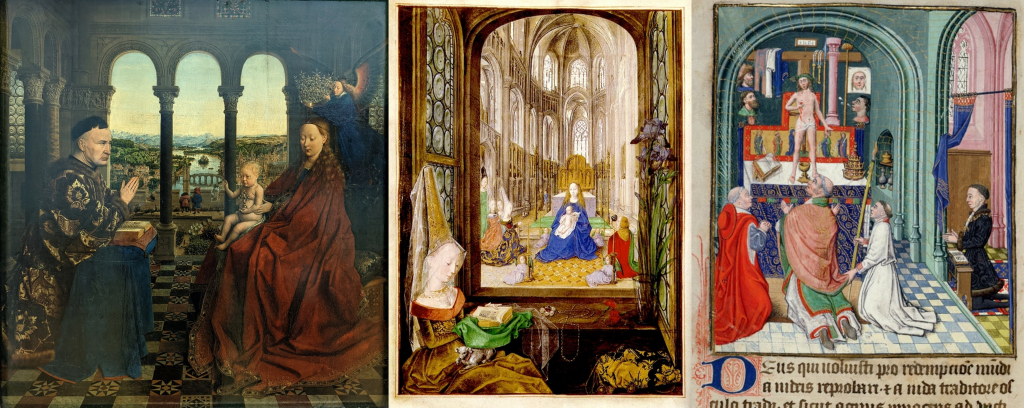
In the fifteenth-century Burgundian court, we find courtly art in which patrons depicted themselves close or within the closeness of sacred persons and religious narratives. As Craig Harbison notes, they are not pictures of intellectual pursuits or liturgical ritual, but of personal religious experience, visions, and meditation. The three Burgundian objects that form the basis of this essay have many things in common. All three were commissioned for or by a prominent figure, all depict the patron at prayer towards a sacred person or scene, and all are reciting the Book of Hours. In the case of the folio from the Hours of Philip the Bold, Philip the Good is kneeling at a prie-dieu witnessing a vision of Christ during the Mass of St Gregory. Surrounding the altar are various instruments of Christ’s Passion alongside depictions of the saints. Philip the Good inherited this Book of Hours from his grandfather, and had numerous pictorial images added around c.1445, including this one of himself. In the Hours of Mary of Burgundy, the owner Mary is seated reading the Book of Hours by a window which opens into the church choir. She too is witnessing, or perhaps having a vision of being brought into the presence of the Virgin and Child. We can identify this as a Book of Hours from the ‘O’ illuminated on the page, from the prayer of Matins of the Virgin ‘Obsecro te’ and ‘O intemerata’. Since this was illuminated for Mary and her husband Archduke Maximillian, Otto Pacht dates this between 1477 and 1482. Book of Hours were sacred objects treasured by their owners. Not only for the sacred prayers and images contained in them, but also because they were a living embodiment of the lives of the owners and their relationships. They were intended for the lay population, but they served as a public, as well as private, display of material wealth, family patrimony, and piety.
The earliest of the three, The Madonna of Chancellor Rolin , painted by van Eyck c.1435, depicts the subject, Chancellor Nicolas Rolin, before the Virgin and Child, unaccompanied by any other earthly and saintly figure. All three of these combine the earthly world with the heavenly realm. They sacralise the secular and bring their own persons into the wider landscape of Christian belief and sacred history. For the sacred is not something static, which stands isolated, but it is imagined, created, and defined within wider cultural norms. The premise of this essay is that all three objects are used by their owners to define an image of themselves. Thus, will focus on the intermingling of realism and symbolism. Of secular and sacred. Whilst the medieval mind would have recognised no such distinction between the political, religious and even personal, the historian can examine how the patron used visible depictions to convey invisible meanings.
Visions and Symbols
The Hours of both Philip and Mary depict the subject, through prayer, being brought into a sacred vision. As Philip reads his Book of Hours, he is brought to the foot of calvary as an image of Christ on the cross appears before him. He is a participant at the Mass of St Gregory. The Adoro te position that Philip adopts was a common usage in medieval art. He is watching the scene, separated from it by the prie-dieu, the tips of his praying hands reaching into the scene almost giving the impression he is being drawn into the vision. A process Harbison would call ‘osmosis’ of the secular and the sacred. Philip is giving the reader the definition of himself as a man whose faith is grounded in the True Presence in the Eucharist, but also that he himself has been deemed worthy by God to witness such a miracle. The text below the illumination is fitting as the arma Christi, or the Instruments of the Passion, which are depicted above. Philip had a devotion to the Mass of St Gregory, and this was associated with a connection to the Church in Rome. We know from records show that Philip regularly made gifts to the pope. In 1423 he gifted six pieces of tapestry of the Virgin Mary, and in 1425 he contributed 1080 gold crowns towards the restoration of the churches of Rome after vandalism during the Great Schism. There is however a deeper political symbolism to this picture. When Philip the Good succeeded to the duchy of Brabant in 1430, he needed to take control of the main town, Brussels. To do this, he showed a deep devotion to the city’s main relic, the bleeding host, or the ‘sacrament of miracle’. Indeed, he commissioned a new chapel for the host, and organised for a meeting of the noble Order of the Golden Fleece in the church to bring the Burgundian elites together to receive miraculous power from the host. Furthermore, through this devotion he solidified his alliance to the papacy against its fights against heretics who challenged the doctrine of transubstantiation, especially followers of John Wycliff in England and Jan Hus in Bohemia. This was the start of a political and religious alliance between the Sacrament, the city of Brussels and the House of Habsburg which lasted well into the seventeenth-century. This depiction upholds the deeply pious and religious character that history has codified of Philip. But also, a fierce proponent of a Western crusade against the Turks, a supporter of the papacy and a unifier of the Burgundian territories. Further to this, depictions within the context of the Mass of St Gregory also carried with it a status symbolism. Later in the fifteenth-century merchant classes and the social climbers all wanted to be depicted as witnessing the Mass of St Gregory. Examples from Master of the Dark Eyes shows illuminations which mimic the Burgundian court have similar decorative, but extravagant illustrations. Thus, it could be said that a depiction witnessing the Mass of St Gregory was a medieval symbol of elite status, both political and social. Indeed, with Philip’s finger reaching into the vision, he is signifying the highest echelon of religious, social, and political status.
For Mary of Burgundy she is brought into a vision of the Virgin with Child. This miniature is from the outset a remarkable and unique depiction of an image within an image. Mary is reading her book and through her prayers she is transported into a scene of adoration of the Virgin. As Pacht notes, however, to understand this one must take a journey back in time to van Eyck’s execution of the Rolin Madonna. In this picture the viewer is drawn through the darkness of the loggia hall into a brightly lit landscape. There are two depictions here. The inside world of Rolin and the Madonna and Child, and the outside world of the landscape. An image within an image, with both being joined by the viewer’s perception. This is the same concept that is being used by the Master of Mary of Burgundy in her Hours. Taken in this light, the depiction of Mary reading her Book of Hours is not the focus, but rather the vision that she has been transported to is the subject of the illumination. What is this vision exactly? If we take a closer look, we realise the image is not actually a church interior, but a depiction which combines elements of a church. The architectural historian Elizabeth Carson Pastan notes that to the fifteenth-century viewer, this scene is taking place in a church chancel, and we are looking at it from a choir window. If we examine the elements shown to us, we see a deacon with a thurible incensing, lighted candles, and the presentation of Christ on a white cloth before the altar. This has all the elements of a Mass which she is worshiping at, and which her husband, Archduke Maximillian is participating at as the deacon. The cloth represents the corporal cloth on which the consecrated host is placed on, mirrored by the green cloth Mary is holding her Book of Hours on in the foreground. Eric Inglis notes that this Book of Hours which she would have used in church reminds herself that Jesus Christ in the Eucharist was an important avenue to divine contact. This scene that is depicted could be described as a meditation of the Sacrifice of the Mass. Indeed, the very fact that in the foreground Mary is looking into the book, rather that out of the window gives us the evidence that in her vision, anything is possible, and this is demonstrated to us by the impossible architecture in the background. In the foreground is the elegant aristocrat Mary, who sits with her ‘irises of purity’ and whom can afford a black book of hours, reserved for the wealthiest nobles. Yet in the background vision she, like Philip her grandfather, is witnessing a scene of Eucharistic adoration. Philip is viewing the Mass said by the seventhcentury St Gregory with Christ appearing on the altar, and Mary observes a window within a window of a symbolised apparition of the mass through the Virgin and Child. For Philip and Mary, through their recitation of the office, they are brought into a sacred scene, and it is through this sacred scene that they are defining their identity.
This perceptive illusion of an image within an image is even more interesting when analysing the Rolin Madonna. The viewer might first be drawn into the apparition of the Virgin Mary and Child, even to the apparent pomposity for him to be receiving absolution from Christ himself, as Harbison notes. Or perhaps even the intricate symbolism of the reliefs on the columns and arches. However, I would posit that van Eyck’s depiction is using the real picture through the arches to define the subject rather than his vision of the Virgin Mary. The landscape behind has been the subject of much historical debate, and scholars have suggested it could be the home of Rolin, Autun, or perhaps Bruges, Prague or even London. The viewer can see a stark contrast between both sides of the river. On the right is an urban sprawling city with high rising ecclesiastical cathedrals and towers. On the left is a green and earthly landscape with villages and diverse scenery. As has been noted, the people on the bridge are moving from left to right. It could be said that these landscapes are depictions of the earthly and heavenly realms. On the right is the symbolism of the earthly patron Rolin, whose countryside with vineyards is representative of Rolin’s endeavours in the Burgundian wine market. We know that he donated many of his vineyards to the Hospice as well as possibly some to the Church or Our Lady in Autun. On the right we have the heavenly Jerusalem, represented as the river glistening and a city of churches.
Harbison acknowledges the duality of the picture with two halves joined together. However he theorises that the truth is drawn from the earthly landscape. That the visible world is ‘employed in order to transcend itself’. But I would suggest that the heavenly vision of the Virgin Mary and Christ Child is employed to sanctify the visible world. To bless and lift up to God the world works of Rolin. On the capital about the Virgin Mary there is one visible sacred narrative, that of Abraham being met and blessed by Melchizedek, one of the Old Testament priests appointed by God. The fifteenth-century viewer would have recognised Melchizedek as the first priest to make a bloodless offering of bread and wine and whose characterisation as a prefiguring of Christ was widespread known. According to Saint Augustine, Jesus was himself made a priest according to the order of Melchizedek. In this light the foreground image can be explained. The Virgin Mary is depicted as the Queen of Heaven being crowned by the angel atop her. On the border of her mantle exclaim the words ‘exaltata sum in Libano’ from the phrase ‘I was exalted like a cedar in Lebanon’. This taken from a personification of Holy Wisdom from the book of Ecclesiasticus, thus exemplifying the Virgin of that title sedes sapientiae. The Christ Child holding the orb and cross as the creator and judge of the world. Christ is not giving absolution, but benediction, and blessing his creation. Rolin’s fruitful works. Furthermore, the fingers of Christ giving benediction reach out from the foreground and meet the background at the bridge, unifying the whole depiction and symbolising the bridge he offers to heaven.
History has been unforgiving on the character of Nicolas Rolin. A man who was an astute politician and shrewd operator. As a Burgundian chronicler commented, he ‘always harvested on earth as though earth was to be his abode for ever’. Indeed he was a moneylender and confidant of the dukes of Burgundy. However, this picture depicts both his earthly victories in trade and power, but also his humility and piety offering his works to Christ. This humility can be exemplified by the vast amounts of space in the loggia and the background above the winding Styx-like river. This space could be representative of prayer, meditations, and visions. It could also be representative of Purgatory, where Rolin assumed he would be heading before the beatified vision. The bridge across the river is a symbol of intercession, and Rolin is seeking the intercession of the Virgin Mary, as the bridge between the human and the divine. I suggest that the depictions of this pictures are twofold. First, Rolin exhibiting and defining himself as the ideal Burgundian man; man of God, planter of vines, creator of treaties and cities. Secondly, the ability for this work to be blessed without intercession by Christ the high priest, and the intercession of the Virgin Mary to intercede for him on his journey to heaven through the vast emptiness of purgatory. We have explored the common theme of the Eucharist in both Philip and Mary, but what about in Rolin? First, we have the allusions to wine. First in the capital above Rolin, where there are carvings depicting the drunkenness of Noah, symbolising the fall of humanity. In the book of Genesis Noah planted the first vineyards and drank too much and became drunk. Then, there is as we have discussed the depiction of Melchizedek above the Virgin, who was the first prophet to offer bread and wine as a sacrifice, prefiguring Christ and the sacramental use of wine. Vines link the two scenes across the capital arches and link together wine as the source of salvation through Christ, but also the business of Rolin as a planter of Burgundian vines. One can almost hear Rolin asking God’s blessing of his works, and the sanctification of them for the salvation of his soul. Indeed, with the donation of vineyards to the Church in Autun and to his foundation the Hospices de Beaune, Rolin knows that he is materially working towards his salvation. This picture is the depiction of the totally of that working.
All three pieces of courtly art are instruments through which the patron depicts invisible meanings through visible art. As Synder comments, these works are both divided and undivided. The political is conjoined with the social and the religious. The hidden meanings are individual within the pictures, but they also account for the totality of the meaning. All three patrons are depicting something about their identity, motivations, and character. May we see in Philip ally of the papacy and a man of the Church, but also a unifier of his lands and ideal duke. Of Mary, a woman humbled before the Eucharist and the Virgin, but also of a graceful, cultured young Burgundian aristocrat. Nicolas is asking us to remember him for his vineyards, for his charity, and his splendour. But then also to offer a prayer for his soul. These works, as Eamon Duffy comments, ‘take us deep into the heart of late medieval lay religion’. It could be said that they also take us into the heart of aristocratic lay political and social identity. Whilst the patrons would have consciousness felt no distinction between the two, it does not mean that they are not visible to the historian in the intricate details of the courtly art they patronised.
Bibliography
Bowman, G W., “Christian Ideology” in Michael J. Sallnow and John Eade, Contesting the Sacred (Eugene: Wipf and Stock, 2013)
van Buren, Anne H. “The Master of Mary of Burgundy and His Colleagues: The State of Research and Questions of Method.” Zeitschrift Für Kunstgeschichte, vol. 38, no. 3/4, Deutscher Kunstverlag GmbH Munchen Berlin, 1975, pp. 286–309
Duffy, Eamon, The Stripping of the Altars: Traditional Religion in England, C.1400-c.1580 (Yale: Yale University Press, 2005)
Ehresmann, Donald L. “Medieval Theology of the Mass and the Iconography of the Oberwesel Altarpiece.” Zeitschrift Für Kunstgeschichte, vol. 60, no. 2, Deutscher Kunstverlag GmbH Munchen Berlin, 1997, pp. 200–26
Freeman, Margaret B., The St. Martin Embroideries: A Fifteenth-century Series Illustrating the Life and Legend of St. Martin of Tours (New York, 1968)
Gelfand, Laura D., and Walter S. Gibson., “Surrogate Selves: The ‘Rolin Madonna’ and the Late-Medieval Devotional Portrait.” Simiolus: Netherlands Quarterly for the History of Art, vol. 29, no. 3/4, Stichting voor Nederlandse Kunsthistorische Publicaties, 2002, pp. 119–38
Harbison, Craig. “Realism and Symbolism in Early Flemish Painting.” The Art Bulletin, vol. 66, no. 4, [Taylor & Francis, Ltd., College Art Association], 1984, pp. 588–602
Harbison, Craig. “Visions and Meditations in Early Flemish Painting.” Simiolus: Netherlands Quarterly for the History of Art, vol. 15, no. 2, Stichting voor Nederlandse Kunsthistorische Publicaties, 1985, pp. 87–118
Harbison, Craig, Jan Van Eyck: The Play of Realism (London, 2011)
King James Bible (Oxford, 2010)
Lacey, Joann, History of Art and Architecture, Book 1 (Indiana, 2021)
Melion, Walter, Pastan, Elizabeth Carson, and Wandel, Lee Palmer, eds., Quid est sacramentum?: Visual Representation of Sacred Mysteries in Early Modern Europe, 1400– 1700 (Turnhout, 2019), pp. 234-235
Pächt, Otto. “The Master of Mary of Burgundy.” The Burlington Magazine for Connoisseurs, vol. 85, no. 501, The Burlington Magazine Publications Ltd., 1944, pp. 295–288
Panayotova Stella, & Binski, Paul, eds., The Cambridge Illuminations: Ten Centuries of Book Production in the Medieval West (Turnhout, 2005)
Pollmann, Judith, Memory in Early Modern Europe, 1500-1800 (Oxford, 2017)
Reinburg, Virginia. “‘For the Use of Women’: Women and Books of Hours.” Early Modern Women, vol. 4, Arizona State University, 2009, pp. 235–40
Rudy, Kathyrn M., Rubrics, Images and Indulgences in Late Medieval Netherlandish Manuscripts (Leiden, 2016)
Snyder, James. “Jan van Eyck and the Madonna of Chancellor Nicolas Rolin.” Oud Holland, vol. 82, no. 4, Brill, 1967, pp. 163–71
Snyder, James, Northern Renaissance Art: Painting, Sculpture, the Grahic Arts from 1350 to 1575 (New York, 1985)
Turel, Noa, Living Pictures: Jan Van Eyck and Painting’s First Century (Yale, 2020)
de Winter, Patrick M., “The Grandes Heures of Philip the Bold, Duke of Burgundy: The Copyist Jean L’Avenant and His Patrons at the French Court.” Speculum, vol. 57, no. 4, [Medieval Academy of America, Cambridge University Press, University of Chicago Press], 1982, pp. 786–842
Appendix
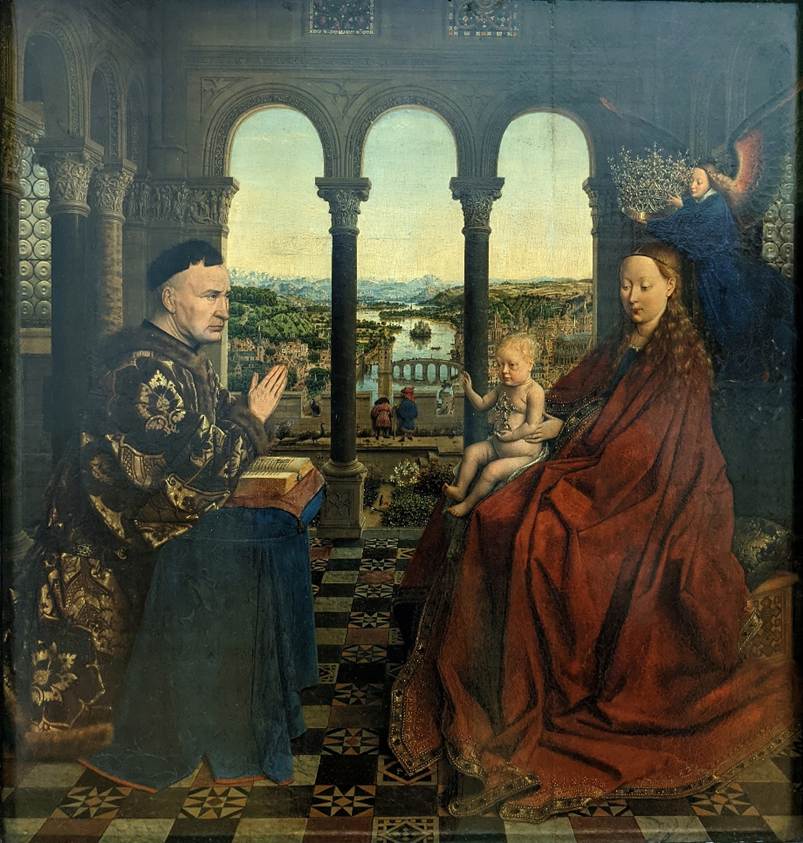
Madonna of Chancellor Rolin, Oil on panel, c. 1435. 66cm x 62cm. Musée du Louvre, Paris
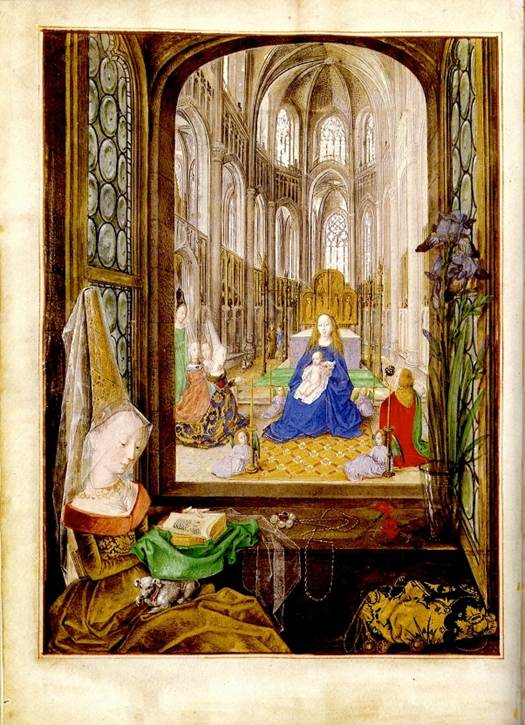
Vienna, Österreichische Nationalbibliothek, Cod. 1857, fol.14v
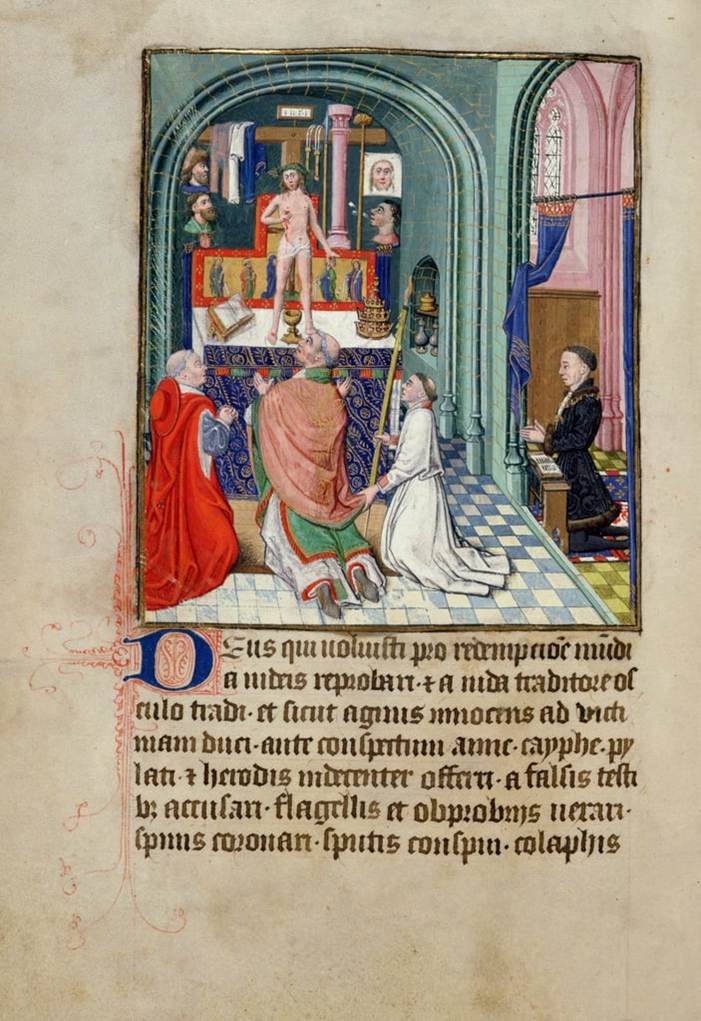
The Fitzwilliam Museum, Cambridge, MS 3-1954 fol.253v
 Izaak Tanna