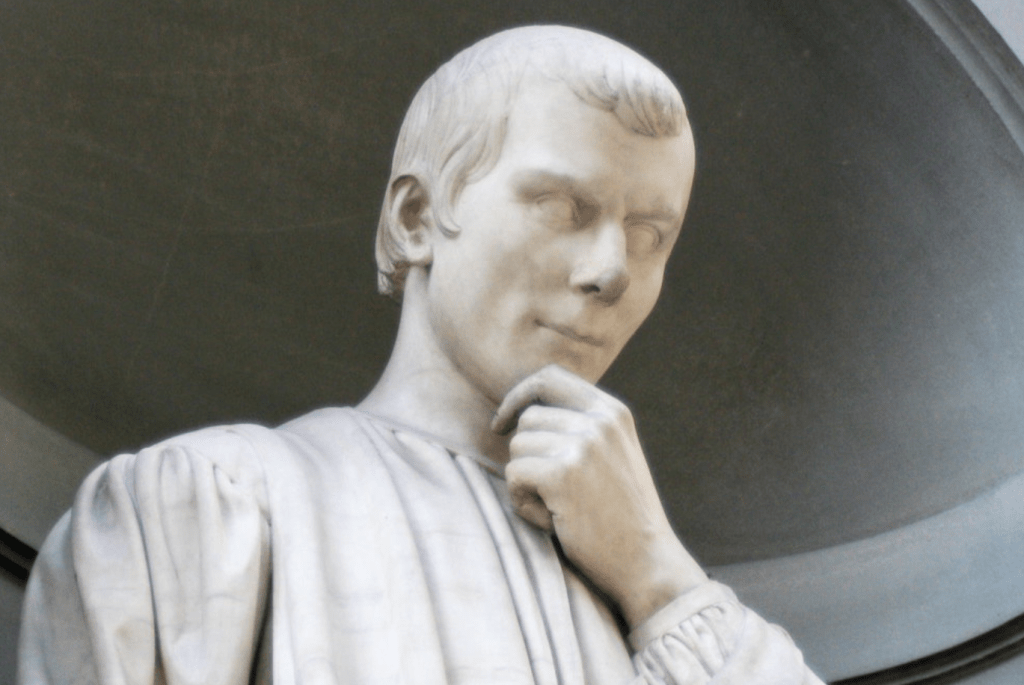
In the year 1512, the Medici regime was restored in Florence, and Niccolò Machiavelli was dismissed from his office in the Florentine Chancellery; exiled to Sant’ Andrea da Percussina. During the succeeding fifteen years, he wrote the literary works that became his namesake, including; The Prince and the Discourses. These two works were, novel and significant development in political thought. This analysis is not based on future events inspired by the virtues of Machiavelli, such as the ‘democratic tyranny’ in the French Revolution, as claimed by Edmund Burke , nor is it a history of the events of the time, but rather an analysis of the forerunners of Machiavelli, in order to determine the true innovation of his works. Numerous times in The Prince and the Discourses, Machiavelli writes that what surprises men the most is something new; the never seen. Machiavelli is the philosopher of something new, because he is the ‘theorist of beginnings’, he is fascinating not because he is new, but because he is the beginning of something new. That being said, this work will contend that the opere of Machiavelli; the basic concepts and tenants of his writings were not wholly novel, but rather the method he employed and the analysis he contributed resulted in his works being classed among the greatest, profound and most innovative, in the history of political thought. His line of enquiry of political thought, “imparata con una lunga esperienza delle cose moderne et una continua lezione delle antique,” was indeed the first of it’s kind.
In discussing Machiavelli’s historical method, it is chiefly important to analyse the way he constructed his ideas, the evidence that he used and the style in which he presented his work. His fundamental purpose was to construct a new methodology that was, on the one hand, reading of history for the sake of practical political purposes, and on the other hand the practise of politics based on the ideals gained by reading history. Indeed Machiavelli himself claimed that through the study of history, one could find both the causes and also the cures of the mistakes of the past. On thinking of Machiavelli’s method, one may describe it as a “neo-classical form of humanist political thought.” One may call this the ‘inductive method’; based on science and observation. It is important to first note that this method of comparison between past and present was not novel. Indeed, it was a method employed by many in fifteenth century Europe, apparent in Philippe de Commines’ Memoires, whose main tenant was that history is of paramount importance to the practical politician. Nevertheless, Machiavelli’s views on the ‘utility of history’ to remain with us to this day. There are three novel theories that Machiavelli uses; the doctrine of ‘imitation’, the discernment of historical recurrence and his ‘faith’ in the dominance of the classical world.
“Debbe uno uomo prudente entrare sempre per vie battute da uomini grandi e quelli che sono stati eccellentissimi imitare…” Machiavelli explains his ‘doctrine of imitation’ further in the Art of War where he says that the princes should adhere and learn from the past experiences of great men. Indeed, the novelty of Machiavelli is shown in the way in which he takes this virtue a step further. He contents in the Discourses that if ‘the princes’ put the lives of great men before them, then they will see the confidence that exists between the governed and the governors, and will thus desire to imitate these conditions. This methodology of historical causation only highlights the novel absolutist nature of Machiavelli. Furthermore, this causation that Machiavelli employs enables him to presume future outcomes from present circumstances. He demonstrates this from history, when he he describes Numa as having a sound religious foundation which led to Rome’s good institutions, which consequently brought good fortune, and good fortune contributed to the success of the city. There are two things to be noted here. Firstly, for Machiavelli, the ‘good’, be it a good city or good fortune was a consequence of various actions, be those principal actions good or bad. Therefore, ‘good’ is a by-product of virtue, not a virtue within itself. Thus, the ends justify the means, “e nelle aziono de tutti gli uomini, e massime de’ principi, dove non e iudizio a chi reclamare, si guarda al fine.” Secondly, this brings up Machiavelli’s concept that states advance from good to evil, and from evil to good; history is cyclical and recurrent, which is the second of Machiavelli’s novelties.
This theory is based on the premise that human nature is unchanging, and that because of this, history, instead of progressing, falls into recurring patterns, not creating anything new. History is not evolutionary, but repeated. This is most evident when compared Machiavelli with his friend, Francesco Guicciardini, who also states a doctrine of historical recurrence. However, Guicciardini notes that various changing factors mean that each historical period is unique in some way. Whereas Machiavelli explains that the general rules of governance and political virtues, whilst gained from history, are universal, and for all times. Accepting that all men are the same, and tend to emulate one another, and that history repeats itself, he suggests that rulers should read history and learn the best from the past, for the benefit of the present. If this is kept, the future is safe for those great leaders. In this claim, Machiavelli looks to the ‘imitation of antiquity’.
However, this imitation is based on his interpretation of antiquity, in regards to the Italy he found himself in at that period. He took the great successes of the Roman empire and translated them into practical political thought for his time, such as described in the Art of War. It is important to note why Machiavelli harkened back to antiquity, as this was not a wholly novel idea. Machiavelli wrote of the Romans not because they had a republic, but because a republic was the governmental form which enabled Rome to achieved great status and power. Indeed, theorist past and present referred to the ancients, but Machiavelli did because of the outcome that could be achieved, not because of some sort of inherent worth or virtue that antiquity held. That being said, the various similarities in Machiavelli, and authors of his time should not be unexamined.
The predecessors to Renaissance political thought are indeed common in some concepts. The ideas in Aristotle’s Politics, Xenophon’s Cyropaedia and Isocrates’ oration To Nicocles are shared throughout The Prince. This amalgamation and ‘cosy community’ of classics and political thought is one thing that makes The Prince common, and not novel. The humanist Franciscus Patricius Senensis, writing sometime before Machiavelli, frequently referred to Isocrates, whilst Erasmus wrote Institutio principis Christiani, referring to Cyropaedia. Indeed, the way in which Machiavelli analyses Cyropaedia was like that of Erasmus, quoting parts that fit his narrative. During this period, Renaissance princes would have claimed Aristotle, Isocrates and Xenophon as the best texts to teach princely behaviours. Charles V was known to have had a keen admiration for the Politics and the Economics of Aristotle. It is therefore the case that Machiavelli’s The Prince would have been familiar to princes of the sixteenth century. Machiavelli, was, as most preceding authors, based on the classical works with a unique adaptation to their aim or purpose. One of the main concerns of the time was the dependency of Italy on the outcome of the struggles between France and Spain, and aid of Spanish soldiers in the overthrow of the Florentine Republic, a chief concern of Machiavelli. The basis of reused classical analysis is evident here in chapter twelve, as he defends the idea of an armed populace, and a rejection of mercenaries and soldiers, as mercenaries have their own interests at heart, whilst the people would have the state’s interests at heart. The population on therefore must defend the state. A intelligent and astute point, however Machiavelli himself defends it by saying that “Settono Roma e Sparta molti scoli armate e libere.” A direct link to antiquity. However, this idea was asserted by Patricius, De Regno, writing before 1492, “Tunc quidem principes militem emunt quum ex civibus suis non habent quem describant, et exercitum conducere conguntur. Mercennarii militis fides ex fortuna pendent, qua quoque inclinante ad hostes plaermque ipsi spem, atque animum eo inclinant…” Furthermore, it is evident that some of the novel terms we associate with Machiavelli are not so novel as presumed. The idea of Fortuna was also written about by Patricius, when he writes that Hannibal was conquered by unfavourable Fortune. So then, the novelty of Machiavelli lies in his analysis of the theory. Whilst the idea of an armed populace was the end within itself for Patricius, for Machiavelli an armed populace was only the means, to a well-ordered state. Indeed, in the Art of War he says that a well-ordered military can keep a state from collapsing despite a badly-ordered civil society. Whereas a well-ordered government with a poorly-ordered military will only end in the downfall of the state.
The novelty of Machiavelli’s analysis is his contradictions. On the one hand he took the contemporary issues, such as the expansion of the Papal states, the French invasion and the intervention into Italian affairs by the Swiss, and used classical ideas to defend certain motivations. On the other hand he criticized classical and contemporary humanism, arguing that if a ruler was to achieve true success, he will not always find it rational to be moral, rather any attempt to be morally virtuous will be irrational. This goes against the Christian objective moral stance, that the wicked man will be punished in the Last Judgment. To this, Machiavelli says nothing, and his silence in this matter is the cause for his perpetual infamy. He bushes aside orthodox Christian ideals, as laid out by Thomas Aquinas, that a good ruler should prefer heavenly rewards and avoid worldly temptations, but claims that the highest prize for men are ‘glory and riches’ – the finest gifts that Fortune can bestow.
When published, The Prince became the subject of violent vilification by members of the clergy, and those who adhered to an absolute morality. He made religion and morality subject to political practice, and defended the virtues of cruelty and violence. The Jesuits were keen to point out that The Prince had been written by ‘the Devil’s hand. Exiled from England after the reformation, Cardinal Pole’s Apologia was the first written attack on Machiavelli. “And such is that book, as I discovered, written by an enemy of the human race. In it are set out all the plans of the enemy and the methods by which religion, piety, and all types of virtue could more easily be destroyed.” He clearly identified one of the most dangerous, and novel virtues of Machiavelli; that political action was different from political thought. Indeed, to understand Machiavelli is to understand the line to enquiry and the perspective that he came from. For Machiavelli, that perspective was the realist ideal that pragmatism was the ultimate tool to be twisted and bent by thee ideal ruler. Indeed, his pragmatism is most evident in his own personal life, with the dedication of The Prince to the ‘Medici lords’, to show himself a loyal subject, as he was previously disfavoured.
Whilst many past philosophers were mainly concerned with ethics, most had nothing practical to say about politics. Nevertheless, Machiavelli noted that whilst many had written on the ‘conduct of princes’, his discussion was of a different method. He aimed to write something useful, rather than an idealised handbook, separate from practical matters. Never did Machiavelli claim to be a revolutionary republican, nor a radical of his time. He held true to the ancients, as he exclaimed in the chapter Delle Conqiure of Discorsi sopra la prima deca di Tito Livio, “che gli uomini hanno ad onorare le cose passate e ad ubbidire alle presenti” Nevertheless, his legacy was revolutionary. His political thought was a new way of thinking, split from the discipline of moral philosophy, and the notion of ‘man’s higher purpose’. His reflections on Renaissance Italy, coupled with his realist method and empirical analysis caused the creation of modern political thought. As discussed, Machiavelli’s predecessors did discuss some of topics he addressed, such as mercenaries, dependence of outside rulers, and the power of Fortune. But in the case of Machiavelli, dependence on the past is a sign of genius rather than failing. “Advance is produced not by completely rejecting the old but by transcending it; the genius masters the old”. Machiavelli is the result of the new and the old, which resulted in something great and novel. It could be said that the political philosophers before him were ‘literary men in politics’, but Machiavelli was a ‘politician in literature’.
Bibliography
Tutte le opere di Niccolò Machiavelli, (London, 1747)
Hale, J. R., Machiavelli and Renaissance Italy (London, 1961)
Althusser, Louis, Machiavelli and Us (London 1999)
Gilbert, Felix, Machiavelli and Guicciardini, Politics and History in Sixteenth-Century Florence (Princeton 1965) utes results in his works being classed as some of the greatest, profound and novel, in the history of political thought. ontrib
Skinner, Quentin, Machiavelli, A Very Short Introduction (Oxford, 1981)
Butterfield, Herbert, The Statecraft of Machiavelli (London 1940)
Anglo, Sydney, Machiavelli: A Dissection (London, 1969)
Pole, Reginald, Apologia ad Carolum Quintum, in Epistolarum Reginaldi Poli (Brescia, 1744-57)
Il Principe, e pagine dei Discorsi e delle Istorie, Niccolò Machiavelli, a cura di Luigi Russo, ed. Sansoni (Firenze, 1967)
Tutte le opere, Niccolò Machiavelli, a cura di Mario Martelli, ed. Sansoni (Firenze, 1971)
Gilbert, Allan H., Machiavelli’s Prince and its Forerunners (New York, 1938)
Dyer, Louis, Machiavelli and the Modern State (London, 1904)

 Izaak Tanna
Leave a comment