
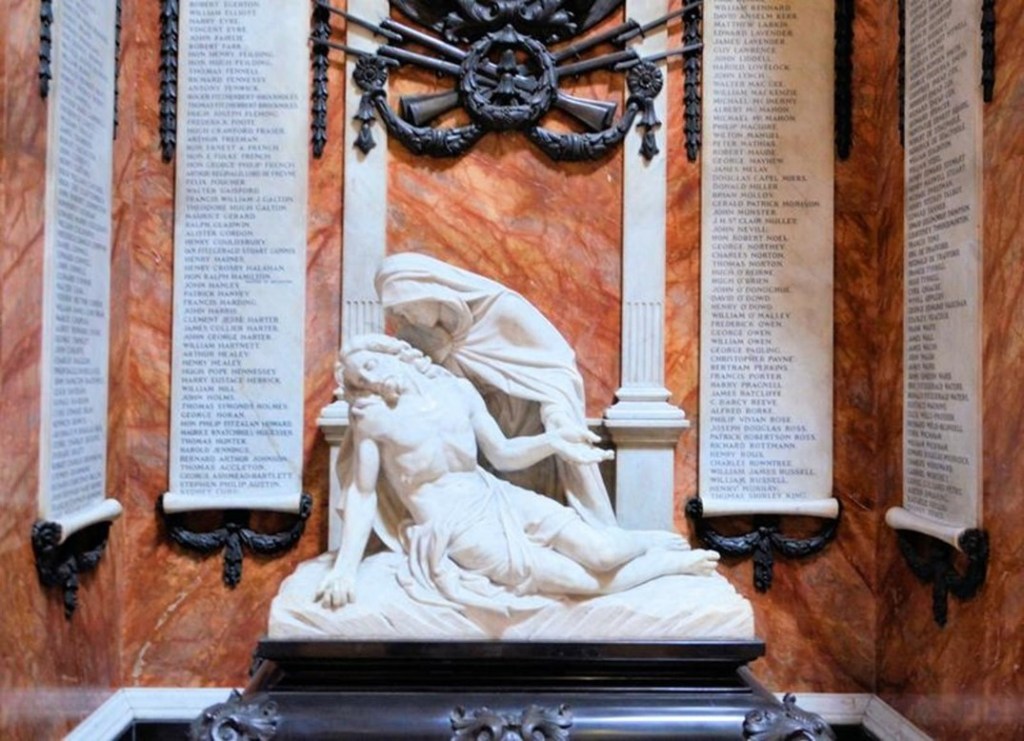
In a unassuming corner of the majestic, neo-baroque church, Brompton Oratory in Knightsbridge, stands a First World War memorial to the two hundred and fifty Catholic servicemen who died in the Great War. Erected in 1921, the Pieta, carved from the marble of the same quarry that Michelangelo used in the 15th century, would not seem out of place in baroque Rome, Naples or even Florence. The Royal Standard above the Pieta, however, gives it away as a British war memorial, and the English and Irish names on the columns above hint at its memorial meaning. The memorial was unveiled and blessed by Cardinal Francis Bourne, the Catholic archbishop of Westminster from 1903 till his death in 1935, and this Catholic First World War memorial is first and foremost a sacred monument. Indeed, as Jay Winter notes Catholic memorials tend to be more sacred than secular. The date of this monument is particularly important. Winter observes that the ‘universality of bereavement’ in post-war Europe explains the appeal of memorials with ‘traditional motifs’ in the 1920s. This could be explained as one of them. Indeed, in his study of war memorials he identifies the dual motifs in war memorials as commemorating war both as noble and uplifting but also tragic and ‘unendurably sad.’ This could be summed in Horace’s ‘Old Lie’ which crowns the monument, “it is sweet and fitting to die for one’s country” in Latin. At the same time this memorial is one of historical remembrance. This can best be summed up as a monument which embodies “not only first-person narratives, but scripts which later generations form and disseminate about significant events in the past.” Remembrance, and indeed monuments, are not simply what the state wishes its people to remember, but are formed by many other actors; religious, secular, families, civic societies, and other political groups and individuals. The actions of these actors are shaped by their own ideas, beliefs, and traditions. This analysis will focus on the 1921 memorial in the Brompton Oratory, to understand the process and understanding of memory and history within both the sacred and the secular realms.
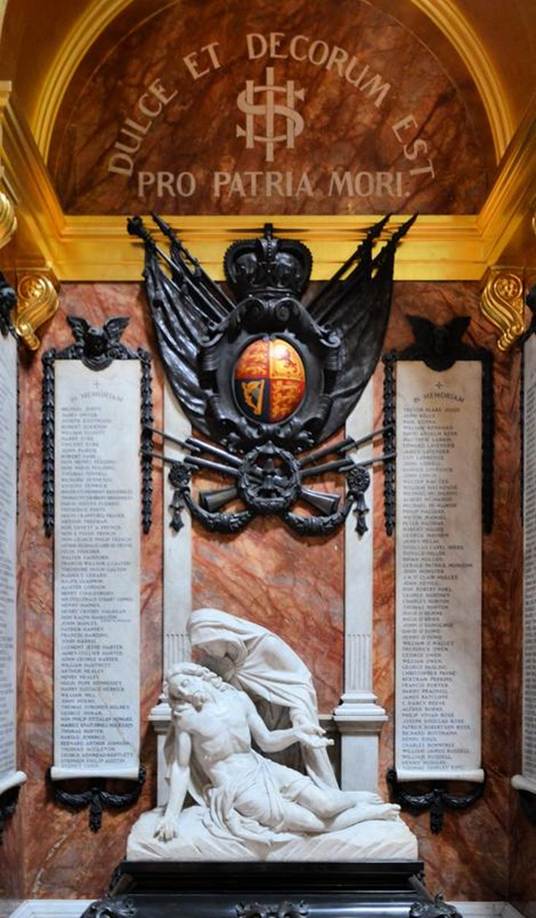
The sentiment in the immediate aftermath of the war was one of unprecedented horror, and the suffering of war was replaced by the necessity for peace. One war memorial reads “and we in faith keep that peace for which they paid.” The change in pre-war to post-war thought was the recognition that war was brutal, and to be avoided. How did this manifest itself in the memory of British society? Through monuments and memorials that belief became embodied as an interwar ideal. This memory was not explicit, but rather in thought and mind. Indeed, memorials rarely contained images of the horrors or war, yet they implied the horrors of it. The Roman Catholic dean of the cathedral in Leeds, when unveiling the city’s war memorial in 1922 reminded parishioners that this monument “may serve to fill us with a horror of war.” Catholic memory, due to its religiously universal nature, was a transnational memory. It housed the nation as the home of sacrifice and mourning, but it also highlighted the importance of transcendent religious ideas as well as the transnational experience within the Catholic framework. But at the same time there was a particularly British Catholic memory which manifest itself alongside the secular British memory. If one looks at contemporary memorials in London, we find a range from national memorials to personal memorials. Lord Kitchener’s chapel in St Paul’s Cathedral contains a Pieta of its own, but most of the national memorials unveiled in 1920 reflect a non-Christian form of commemoration of the empire’s dead. The cenotaph for instances takes an ancient Greek theme, and the dedication on the tomb of the unknown warrior notes he died ‘for King and country, for loved ones, home and Empire’. This is a specific sense of Englishness that is missing from the Brompton Oratory. Indeed, the Royal Standard is the only thing that gives away it as British. Indeed, this Pieta has more in common with Bavarian and French Catholic memorials than with British neoclassical ones. This exemplifies the universality of the Catholic experience of war, and the changing nature of remembrance and commemoration.
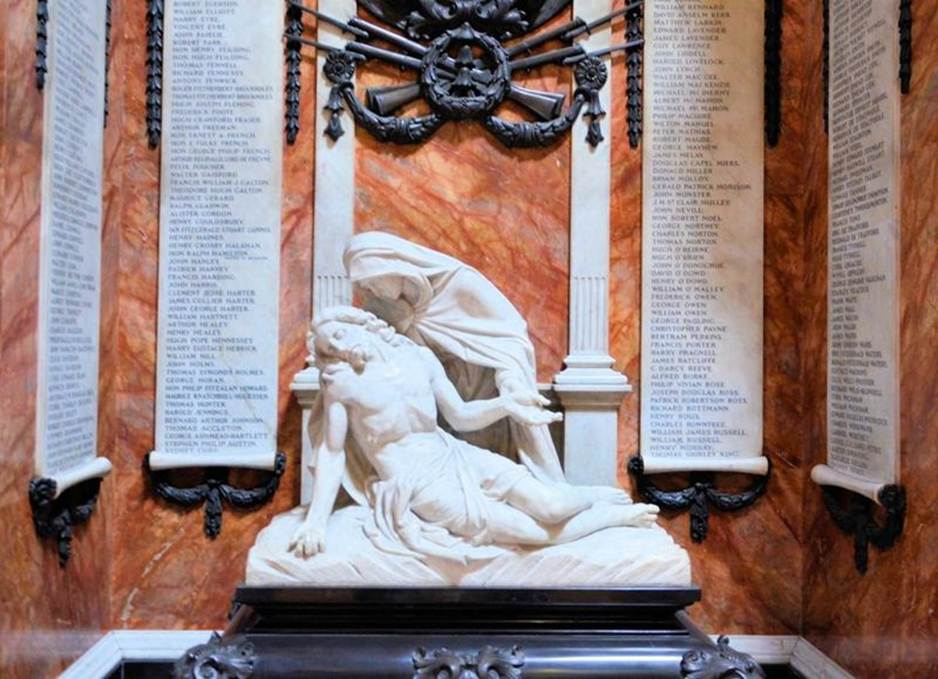
The casualties of the Great War were in fact so vast that many names and bodies remained absent from burial. Soldiers were buried on site in makeshift graves, and thus memorials and commemorations such as this had to embody the fact of missing actual bodies. The Pieta makes this reality bearable as Christ takes the place of all those missing names and bodies. Indeed, the Catholic memorialisation helped to materialise this, and the doctrines of the Communion of the Saints and the saintly intercession of the Blessed Virgin Mary as depicted in the statue helped Catholics make sense of the sacrifice of war in a Catholic way and brought about consolation and healing through it.
The Pieta statue used in the memorial was a well-suited motif in war memorials in the interwar period. Indeed, it also tells us about the Catholic notion of commemoration and sacrifice, and apt to express the sadness and loss. In contrast to the nineteenth-century monuments of masculine strength witnessed all throughout London, the Pieta is humane, humble, and centres on the feminine. It brought all people, men, and women, into the memorialisation and focused attention of families and communities, rather than individual heroism. The Pieta, then, was a way to communicate to the masses, and called to mind the suffering and sacrifice, not only the valour. It allowed all people to link their suffering and loss to that of the Blessed Virgin Mary’s loss of her son, the Christ. At first glimpse we might think that the Pieta tells us something about the nature of a neo-baroque monument in London, but in fact it tells us about the nature of memory and commemoration in the near aftermath of the war. Indeed, many Pietas like it exist throughout Europe, both in wood and in marble, in a classical or a baroque design. Winter notes that these Pieta statues were the centre of female bereavement from lost men during the war. This is true, but it is important to note that through this it kept the grief within ecclesiastical and religious institutions. Furthermore, the notion of female grief and female participation in memorialisation is one which exists in some places and not others. In Germany for instance the Pieta represents the silence of the female mourners but in France or Britain it functions both as the centre of this grief, but also an acknowledgement of the female participation in the war effort. The female mourner, represented here as the Virgin Mary, appears frequently in interwar memorials, be it mourning mothers, wives, or female representations like Mary. In the religious context, the male sacrifice stood in contrast to the female mourner who wept for her sons, husbands, brothers, and people of the nation. Mary could even stand for the non-combatants who mourn the war and the deaths of their loved ones. Indeed, it represents the prophecy of Simeon with the “sorrows of Mary” for the death of her son. Nothing exemplifies this sorrow more than the Pieta. The common use of the Pieta and symbols like it in the interwar period did not necessarily correspond to the reality that men and women faced during the war. Rather, it was one of the interwar traditions that reinforced the traditional social hierarchy of the period. Women were not non-combatants during the war, but rather active players. This memorial then represents not the reality of the experience of war, but rather the ideal.
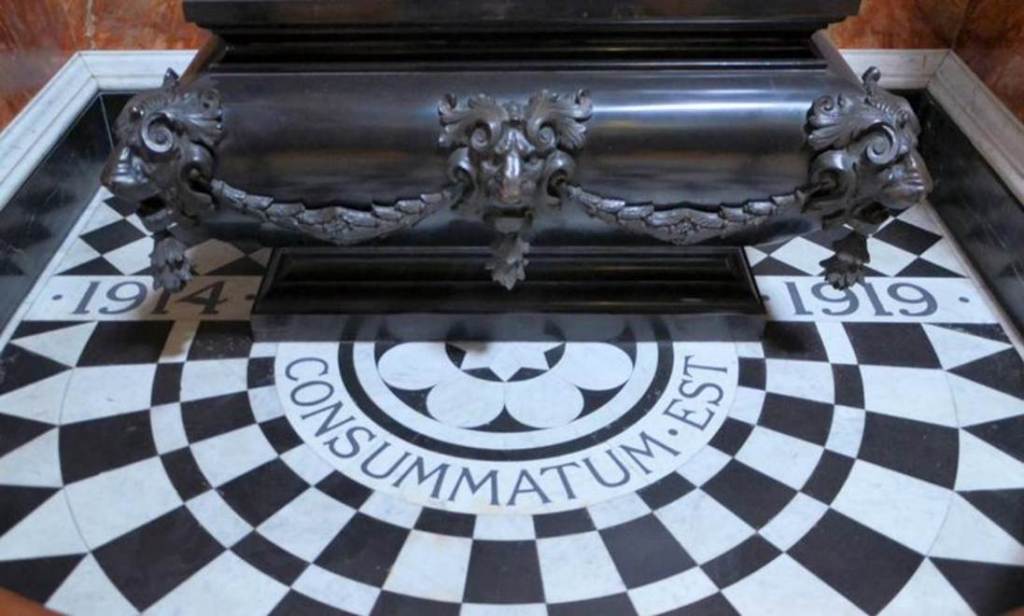
The floor of the memorial is grounded with the words Consummatum Est, the last words that Christ spoke on the cross. Around this is engraved the years of the war 1914-1919. This is significant since the Armistice was signed on 11 November 1918 however the year 1919 signifies the formal ending with the Treaty of Versailles. The words, like the Pieta, make comparison the suffering of Christ to the suffering of soldiers, and give thanks for the ending of war. It does not celebrate the dead but recalls their agony. The universality of this suffering, not simply on each national side, but the universal experience from a Catholic perspective is well documented. Indeed, there are many examples of German Catholic priests administering the sacraments to British prisoners. A Catholic soldier’s report from 1919 records that “during seven sad months of captivity there was only one bright day, when a German priest came and all the Catholic prisoners, French and English, were permitted to receive Absolution and Holy Communion.” Christ’s words ‘it is finished’ is a memorial of remembrance and a memorial of thanks that the universal horrors of the war are over.
The war did much to dispel the negative opinions and prejudice that many people had about Catholics in Britain. Many soldiers were impressed with the devotion and courage of the Catholic chaplains during the war. Indeed, they were more effective and loved by soldiers than their Anglican counterparts. Robert Graves wrote that “for Anglican regimental chaplains we had little respect. They were under orders to avoid getting mixed up with the fighting and stay behind with the transport… For Roman Catholic chaplains were not only permitted to visit posts of danger, but definitely enjoyed to be wherever fighting was, so that they could give Extreme Unction to the dying.” And Guy Chaplain, a fellow officer wrote that “The Church of Rome sent a man into action mentally and spiritually cleaned. The Church of England could only offer you a cigarette.” The Brompton Oratory memorial brings into mind that Catholic element of universal remembrance, because the Catholic faith is one of universal sacrality. It passes through national lines, through the universal sacramental cleansing which Guy Chapman speaks of. The names on the scrolls are remembered both by their countrymen, by their wives, daughters, and sisters that they left behind, but most importantly by God and his community on earth, the Church. Memory and commemoration are key features of Catholic practice and can be seen through prayers for the dead, intentions said at Mass, and indeed commemoration services for the war, which are all regular parts of Catholic worship and remembrance. In the same way the Pieta calls to mind the memory of Christ’s sacrifice on the cross, so too do the names on the scrolls, bringing to memory the suffering of those in war. Commemoration for Catholics is a living practice, and those who died are kept alive through prayers by the living, for the dead. Those who died in the war need the prayers of the living to be united to God, passing through the state of purgatory to heaven. Remembrance of the past by the Catholic community in Britain cannot be separated from the ongoing values which they hold. The historical link is how their ideals are transmitted from the past to the present. Some historians have argued that communities can idealise the past in order to protect it from the present. The commemoration is idealised through the sacralisation of the monument. Sacred memorials like the Brompton Oratory allow the community of Catholics, those who experienced the war, and who would have been witnesses in 1921 at its unveiling, but also those living today, to take part in this living history and universal sacrality. Living in the sense that Catholics passing past it today offer prayers for those names on the scrolls.
War memorials such as the one in the Brompton Oratory remain part of the diverse and multifaceted Great War memorials that exist, be them pyramids, crosses, national flags, allegorical figures, or like ours the Pieta. None of these actually depict the horror of war, but yet built into them is the memory of it. For many, the invention of traditions keeps these memorials alive, but with the death of that generation, none are personally remembered, some become tourist attractions, and many others fall into the fabric of society and history. What Jay Winters calls ‘artefacts of a vanished age.’ For the Brompton Oratory, however, its monument is a piece of living history, kept alive by the living commemoration of the Catholic Church. It is both a secular memorial which teaches us about the traditional values of 1920’s society, but also about the transnational and sacrament universality of the Catholic experience. It remains one of the most remarkable war memorials in London, and a living testament to the memory and history of the Catholic experience during the war. It would only be after the Second World War that British, and European societies alter their attitudes towards memorialisation from that of sacrifice and nobility to more abstract and universal values. It may be fitting to end by mentioning its significance as a Cold War drop-spot for Soviet Spies, as a place of living history. As the Head of Directorate K mentions, “Go into the church. Just to the right of the entrance is an altar. It is a memorial to Englishmen who were killed in the war and has a copy of Michelangelo’s famous statue ‘Pieta’ – the dead Christ in his mother’s arms… The DLB site is behind the column nearest to the wall, in a little space between the actual column and the wall… I would be inclined to think that there is no safer place in Central London”
Bibliography
Andrew, Christopher M., & Gordievsky, Oleg, eds., Comrade Kryuchkov’s Instructions (Stanford: Stanford University Press, 1993)
Crouthamel, Jason & Leese, Peter, eds., Psychological Trauma and the Legacies of the First World War (New York: Springer, 2016)
Frantzen, Allen J., Bloody Good: Chivalry, Sacrifice, and the Great War (Chicago: Chicago University Press, 2004)
Grayzel, Susan R., & M. Proctor, Tammy, eds., Gender and the Great War (Oxford: Oxford University Press, 2017)
Houlihan, Patrick J., Catholicism and the Great War: Religion and Everyday Life in Germany and Austria-Hungary, 1914–1922 (Cambridge: Cambridge University Press, 2015)
King, Alex. Memorials of the Great War in Britain : The Symbolism and Politics of Remembrance, (London: Bloomsbury Publishing Plc, 1998)
Macleod, Jenny. “Britishness and Commemoration: National Memorials to the First World War in Britain and Ireland.” Journal of Contemporary History 48, no. 4 (2013), pp. 647–65
Madigan, Edward. The Clergy in Khaki : New Perspectives on British Army Chaplaincy in the First World War (London: Taylor & Francis, 2013)
Mayo, James M. “War Memorials as Political Memory.” Geographical Review 78, no. 1 (1988): 62–75
McCartney, Helen B., “The First World War Soldier and His Contemporary Image in Britain.” International Affairs (Royal Institute of International Affairs 1944-), vol. 90, no. 2, (Wiley, Royal Institute of International Affairs, 2014), pp. 299–315
Plater, Charles, Catholic Soldiers (London: Longmans, Green and Co., 1919)
Turnham, Margaret H., Catholic Faith and Practice in England, 1779-1992 (Woodbridge: Boydell Press, 2015)
Winter, Jay, Sites of Memory, Sites of Mourning (Cambridge: Cambridge University Press, 2014)
Winter, Jay, “Commemorating War, 1914-1945,” in Roger Chickering, Dennis Showalter, and Hands Van de Ven eds., The Cambridge History of War, vol. 4: War and the Modern World (Cambridge: Cambridge University Press, 2012)
Winter, Jay, Remembering war: The Great War between memory and history in the twentieth century (New Haven: Yale University Press, 2006)

 Izaak Tanna
Leave a comment